
Understanding Asphalt Cracking So You Can Catch Problems Early and Protect Your Investment
Cracks in your asphalt driveway or parking lot rarely appear overnight, and they rarely appear for no reason. Every crack tells a story about what the pavement has been through, and understanding that story is the difference between a repair that holds and one that fails again within a season. At DC Paving and Sealcoating, we are a locally owned, family-operated company with over 20 years of experience serving Tyler, Longview, Marshall, and the greater East Texas region. Our crews have assessed and repaired asphalt surfaces across Smith, Gregg, Harrison, and surrounding counties, and we have seen every form of pavement deterioration that the East Texas environment produces. When you understand why asphalt cracks, you can make smarter decisions about maintenance, catch problems before they become expensive, and know when to call a professional rather than waiting for damage to compound. Here is what is actually behind those cracks.
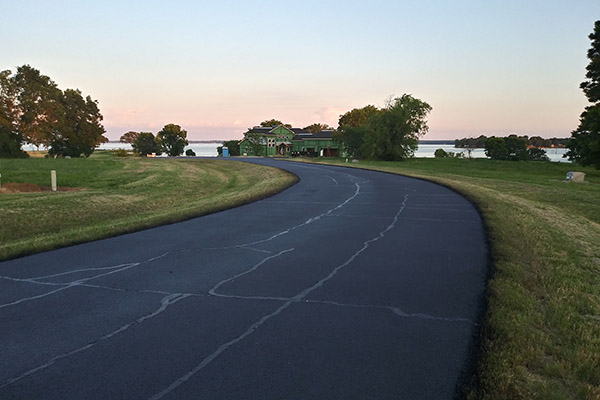
Thermal Expansion and Contraction: East Texas’s Primary Culprit
Of all the forces working on asphalt in East Texas, thermal stress is the most relentless and the least discussed. Asphalt is a flexible material that expands in heat and contracts in cold. In a climate like ours, where summer surface temperatures regularly reach well above the air temperature and winter nights can drop into the low twenties or teens, the pavement is cycling through that expansion and contraction repeatedly throughout the year.
Over time, that repeated movement fatigues the asphalt’s molecular structure. The binders that hold the aggregate together become stressed at the points where movement is greatest, which are typically surface joints, edges, and areas over any slight variation in the base beneath. Eventually, the material can no longer accommodate the movement elastically, and it cracks.
This process is accelerated by UV oxidation, which is also severe in East Texas. As pavement ages and is exposed to direct sun, the oils in the asphalt binder slowly evaporate and break down. This makes the material progressively more brittle and less able to flex through thermal cycles without fracturing. Fresh asphalt is resilient. Oxidized, oil-depleted asphalt is not. This is why sealcoating, which replenishes surface protection and slows oxidation, is one of the most important maintenance steps for any asphalt surface in our region.
Freeze-Thaw Cycles: The Winter Damage Most East Texans Underestimate
East Texas does not experience the severe winter conditions that northern states face, but we do experience enough freeze events to cause meaningful pavement damage, particularly in combination with the other stressors our climate produces.
The mechanism is straightforward. Water infiltrates surface cracks and the porous structure of aging or unsealed asphalt. When temperatures drop below freezing, that water expands as it freezes, physically widening whatever void it occupies. When it thaws, it contracts and pulls back, but the crack or void it has widened does not return to its original size. Each freeze-thaw cycle advances the damage incrementally.
In East Texas, where we may see multiple freeze events within a single winter and where many asphalt surfaces already have surface cracking from thermal stress and oxidation, this mechanism is a significant contributor to accelerating crack progression from surface-level nuisance to structural concern. Water that gets under the surface does not just stay there. It weakens the base material, which then subsides unevenly and causes the asphalt above to crack further as its support is compromised.
The practical implication is that cracks that seem manageable in October can deteriorate meaningfully over a single winter. Addressing them before cold weather arrives is not premature. It is the correct sequence.
Heavy Traffic Loads and Inadequate Base Preparation
Asphalt is engineered to carry specific load types and volumes. When the actual load it experiences exceeds its design capacity, or when the base beneath it was not properly prepared to support the anticipated load, structural cracking develops.
This is particularly relevant for commercial parking lots in the Tyler area, where a surface designed and installed for standard passenger vehicle traffic may now accommodate delivery trucks, larger commercial vehicles, or heavier traffic volumes than originally anticipated as businesses grow. The repeated flexing of asphalt under loads it was not designed to carry creates what is called fatigue cracking, sometimes called alligator cracking because of the interconnected pattern it produces that resembles alligator skin.
Inadequate base preparation during original installation also contributes significantly. A properly built asphalt surface requires a well-compacted, stable base of appropriate depth to distribute load and resist water infiltration. When the base was originally installed incorrectly, too thin, improperly compacted, or without adequate drainage consideration, the pavement above it will develop structural problems regardless of how well the asphalt itself was installed. Base failure is the most expensive category of asphalt problem because addressing it correctly requires removing the existing pavement and rebuilding from the ground up.
Poor Drainage and Water Intrusion
Water is asphalt’s most persistent enemy, and poor drainage is the condition that keeps water in contact with pavement surfaces and base materials for extended periods. East Texas receives significant annual rainfall, and properties where the grade directs water toward the pavement surface rather than away from it, where drainage inlets are inadequate for the volume generated, or where landscaping creates conditions that pool water adjacent to the pavement, are seeing accelerated damage from water exposure.
Standing water softens the base material over time, leading to the base subsidence that creates potholes and structural cracks. It also infiltrates the surface and participates in the freeze-thaw cycle described above. Edge cracking, which appears along the perimeter of driveways and parking lots, is frequently a drainage problem where water is saturating the base at the edge of the pavement footprint.
Tree Root Growth
This cause is often the most visually obvious because of the dramatic heaving it produces, but it is also frequently underestimated in how widespread it is in established East Texas neighborhoods and commercial properties. Tyler and the surrounding communities have substantial tree canopy, and the root systems of established trees do not stop growing when they reach the edge of a paved surface. They grow beneath it, following water and seeking volume.
As roots grow in diameter, they push upward against the underside of the asphalt. The pavement eventually cracks and heaves along the root path. The damage this produces cannot be corrected by surface repair alone. The root growth must be addressed, and in many cases, the affected section of pavement must be removed, the base regraded and compacted, and new asphalt installed.
For property owners with established trees adjacent to driveways or parking lots, monitoring the pavement surface adjacent to tree lines annually for early signs of root-driven heaving is worthwhile. Early intervention is significantly less expensive than addressing a situation where roots have pushed up several sections of pavement.
Age and the Natural Lifecycle of Asphalt
Even properly installed, well-maintained asphalt has a finite lifespan. Without any of the specific stressors described above, the binder in asphalt naturally degrades over time through oxidation, UV exposure, and the cumulative fatigue of normal use. Most asphalt surfaces that receive regular maintenance, including sealcoating every two to three years and timely crack repair, have a functional lifespan of 20 to 30 years. Surfaces that receive no maintenance deteriorate significantly faster.
The practical message is that cracks in an older surface are often a signal not just about the surface but about where the pavement is in its overall lifecycle. A thorough assessment by a professional can distinguish between surface cracking that responds well to crack filling and sealcoating, and structural deterioration that indicates the pavement is approaching the end of its useful life and that a repaving decision is approaching.
At DC Paving and Sealcoating, we give our East Texas clients honest assessments. If a surface can be meaningfully extended through maintenance, we say so and do that work. If the condition has progressed to the point where repaving is the economically correct choice, we say that too.
Seeing Cracks in Your Asphalt? Contact DC Paving and Sealcoating Today.
DC Paving and Sealcoating serves residential and commercial clients throughout Tyler, Longview, Marshall, and the greater East Texas region with asphalt paving, sealcoating, crack filling, and repair services backed by over 20 years of local experience. Contact us today for your free assessment and let our team tell you exactly what is causing your pavement issues and what it will take to fix them right.